Bridge, bay, and island line up in one view
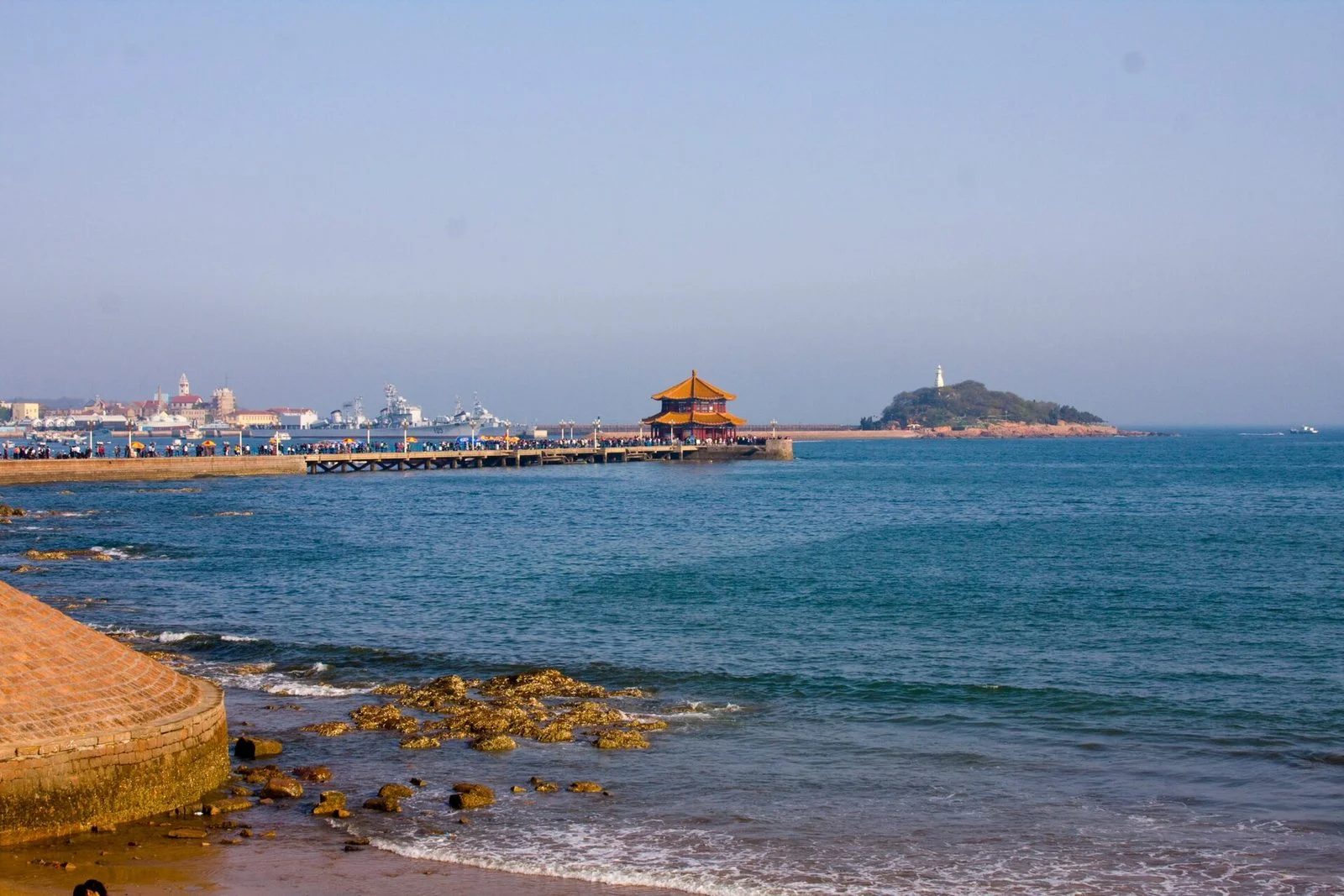
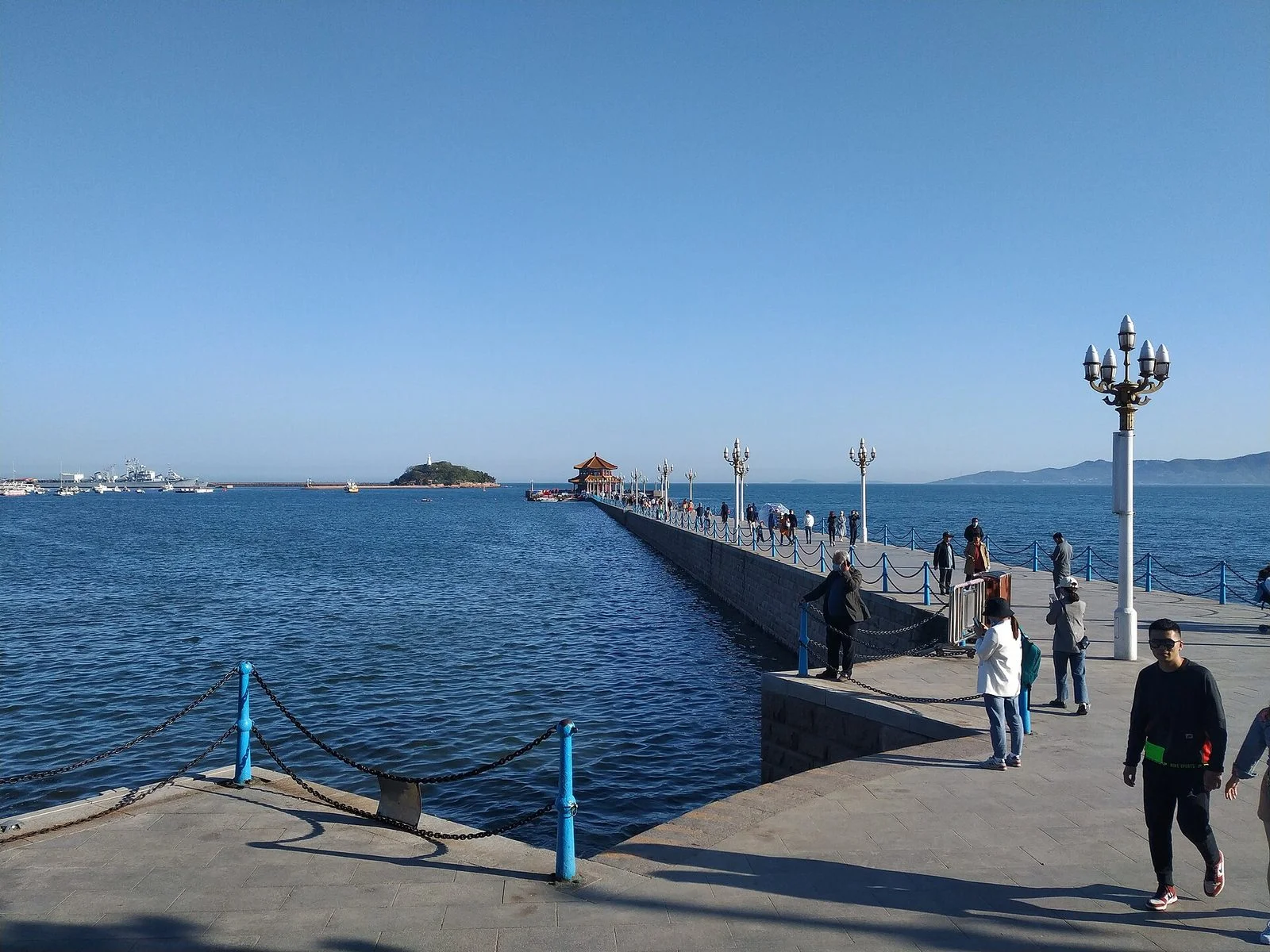
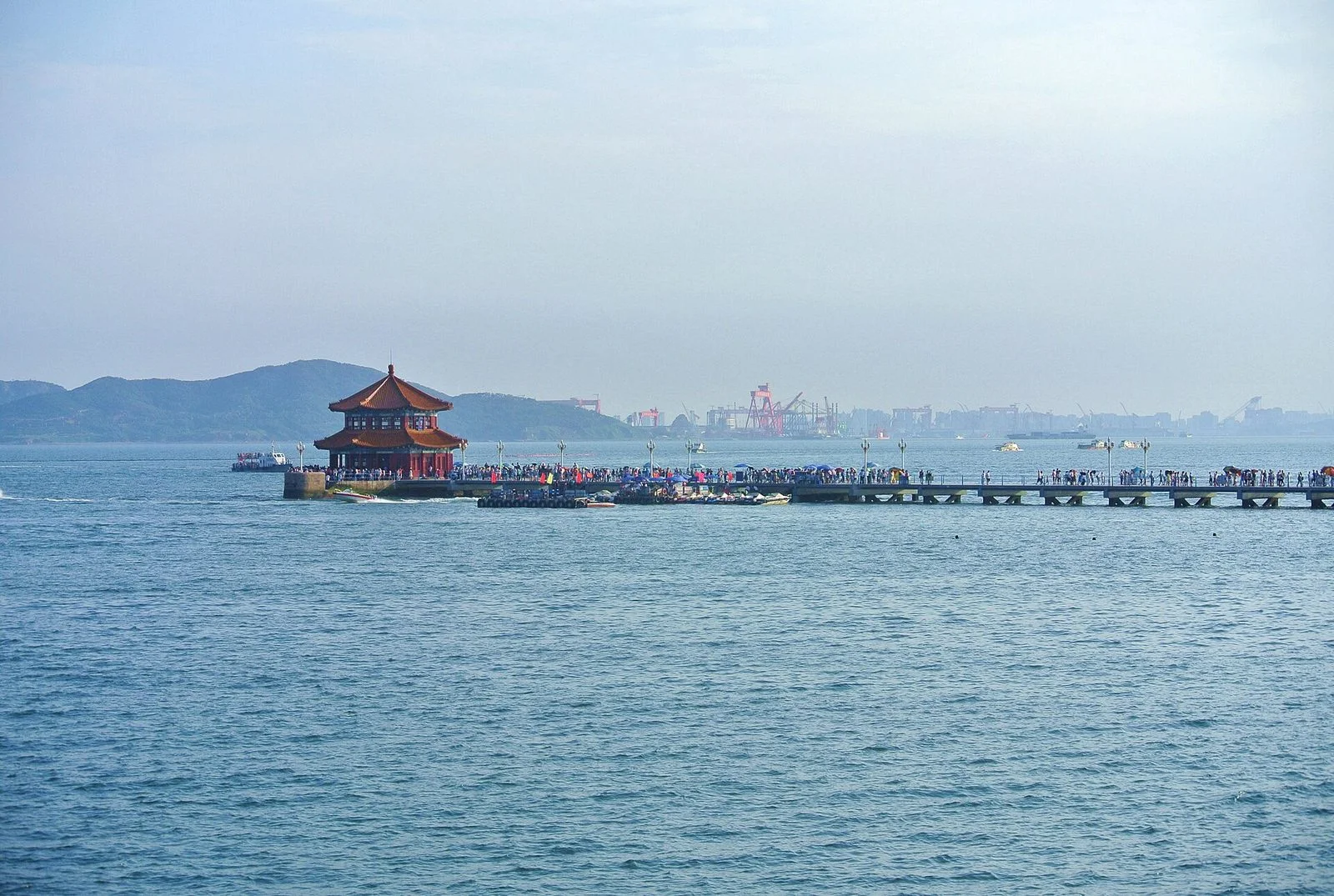
Zhanqiao Pier stands at the southern end of Zhongshan Road, on the Taiping Road waterfront. It runs south-southeast from the shore into Qingdao Bay. The bridge is 394.38 meters long, about 440 meters including the embankment island at its southern end, and 8–11.5 meters wide. This is not a bridge for vehicles but a promenade that carries people from land out over the water. It consists of a stone-faced approach causeway at the northern end, an open span in the middle, and the embankment island at the southern end. The deck is paved with stone slabs and flanked by chain railings and a row of spherical lamp posts. At the tip, Huilan Pavilion stands on the semicircular island; only when you turn around do you see the old city onshore.
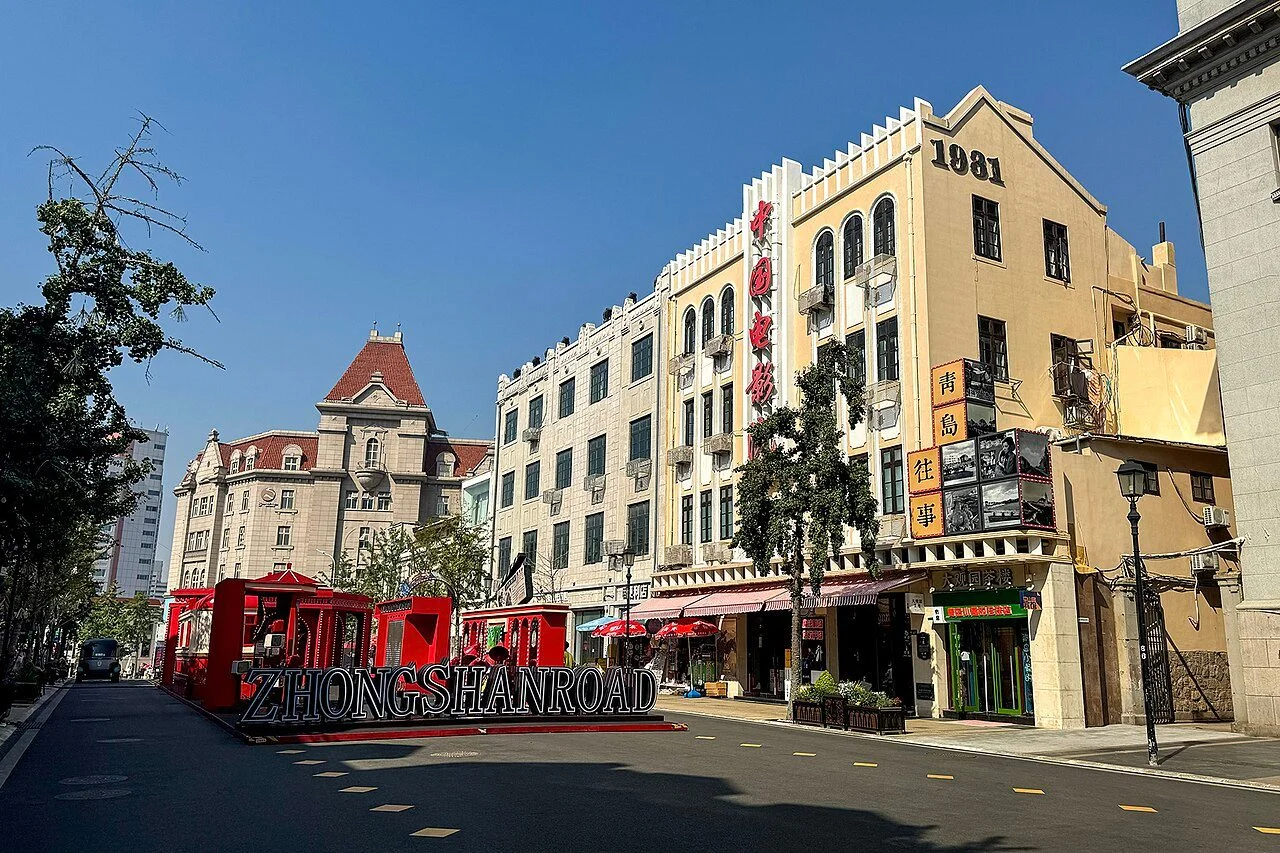
Little Qingdao lies west of the pier, with a white lighthouse on the island. At low tide, the reefs on both sides of the bridge emerge; at high tide they disappear underwater, leaving only the island's silhouette. The pier, Huilan Pavilion, Little Qingdao, and the red-tiled roofs behind them form a common telephoto composition in Qingdao Bay: railings and crowds in the foreground, the pavilion in the middle distance, and the lighthouse and ridgeline beyond. Zhongshan Road, the old commercial street, faces the bridgehead directly, so Zhanqiao is not only a seaside sight but also the endpoint of the old city's axis.
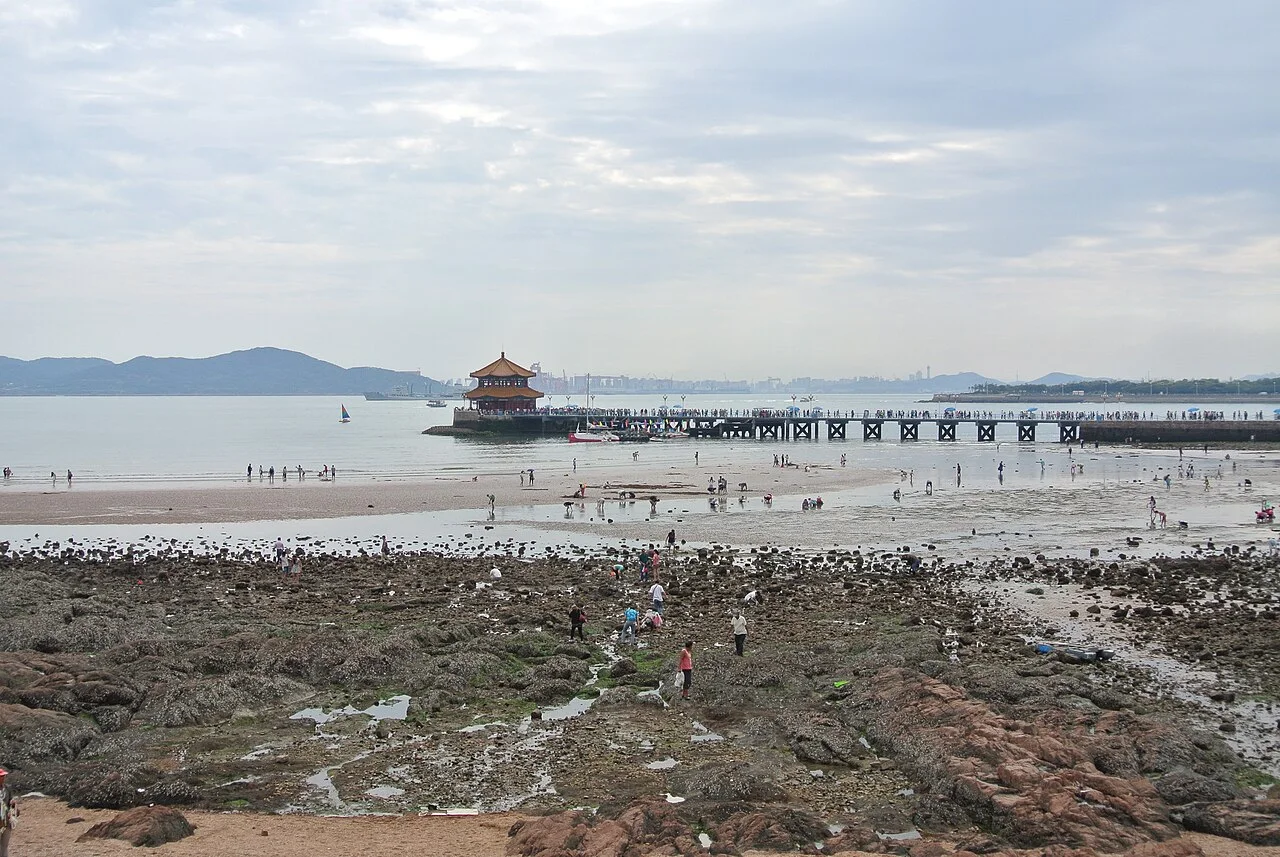
Huilan Pavilion: A 1933 structure, not a late Qing original
The pier's starting date is often given as 1892: after Zhang Gaoyuan led Qing troops into Qingdao, a wharf was built for mine-laying boats and military supplies, initially about 200 meters long. Tradition holds that it was completed in late spring 1893, but construction continued afterward. During the German occupation it was extended to 350 meters and fitted with a light railway. The municipal expansion of 1931–1933 brought it to its present scale: the bridge was extended to 394.38 meters, the deck raised by about 0.5 meters, and a semicircular embankment built at the southern end. On the embankment stood an octagonal pavilion with double-tiered eaves, completed in 1933 and named Huilan Pavilion.
Huilan Pavilion is covered in yellow glazed tiles and surrounded by 24 round columns. It occupies a site of 151 square meters, with 340 square meters of floor area. Inside is a two-story circular hall with a 34-step spiral staircase in the center; in the past, visitors could climb it for views over the bay. In 1936, Qingdao selected its Ten Scenes, and 'Flying Pavilion, Returning Waves' ranked first. The pavilion has served as an exhibition hall, teahouse, and reading room; in 1953 it was briefly renamed the Sino-Soviet Friendship Pavilion, and in 1958 it recovered its present name. The bridge seen today is not the 1930s original either: during major repairs in 1984–1985, the open span was demolished and rebuilt with 17 openings; part of the structure collapsed in 2013 and was repaired in 2014. Keep the 1892 starting point, the 1933 pavilion, and the later repairs distinct, or 'a century old' may be mistaken for a bridge that has never changed.
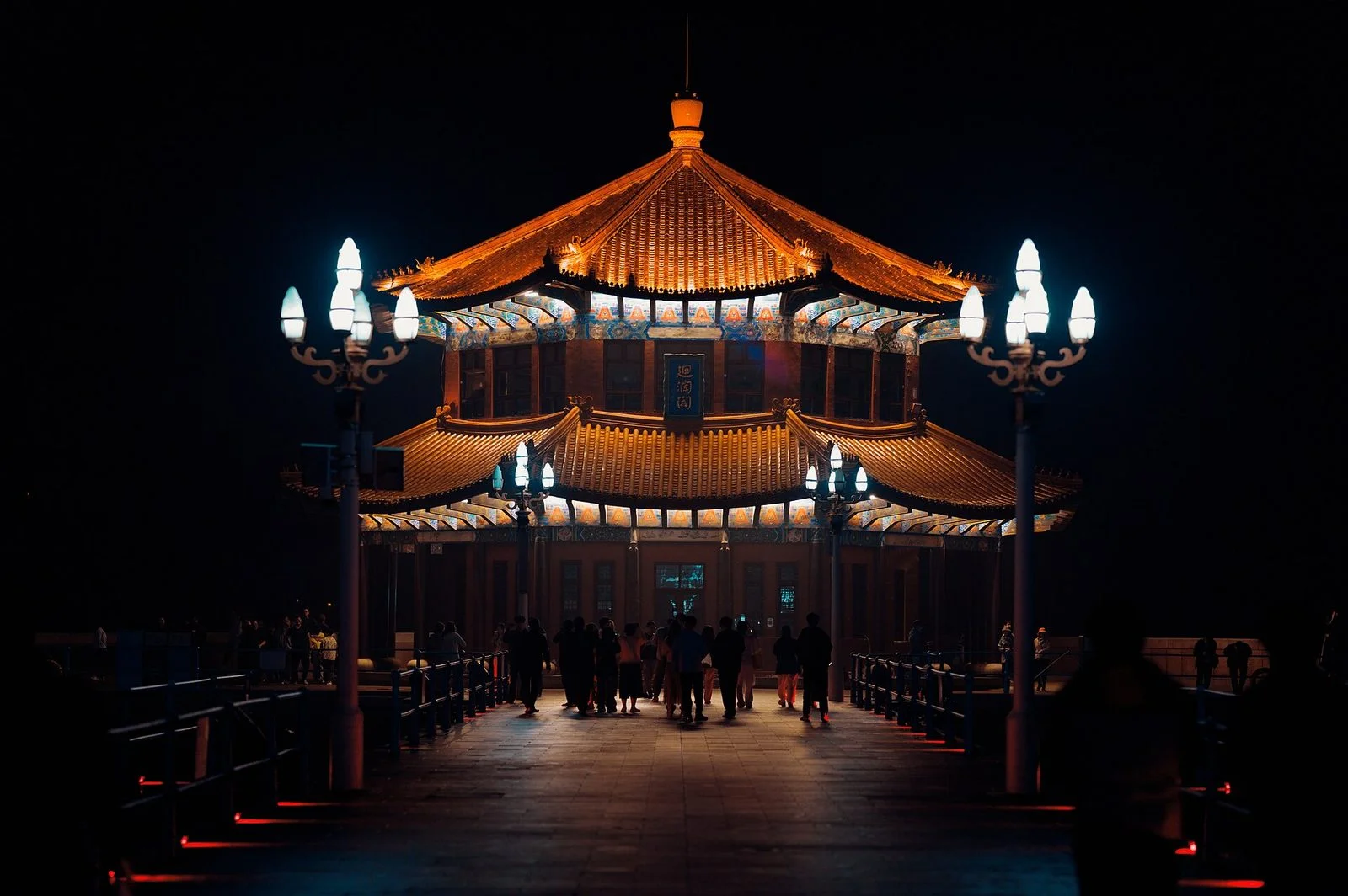
On the pier: Narrow, exposed, and crowded at both ends
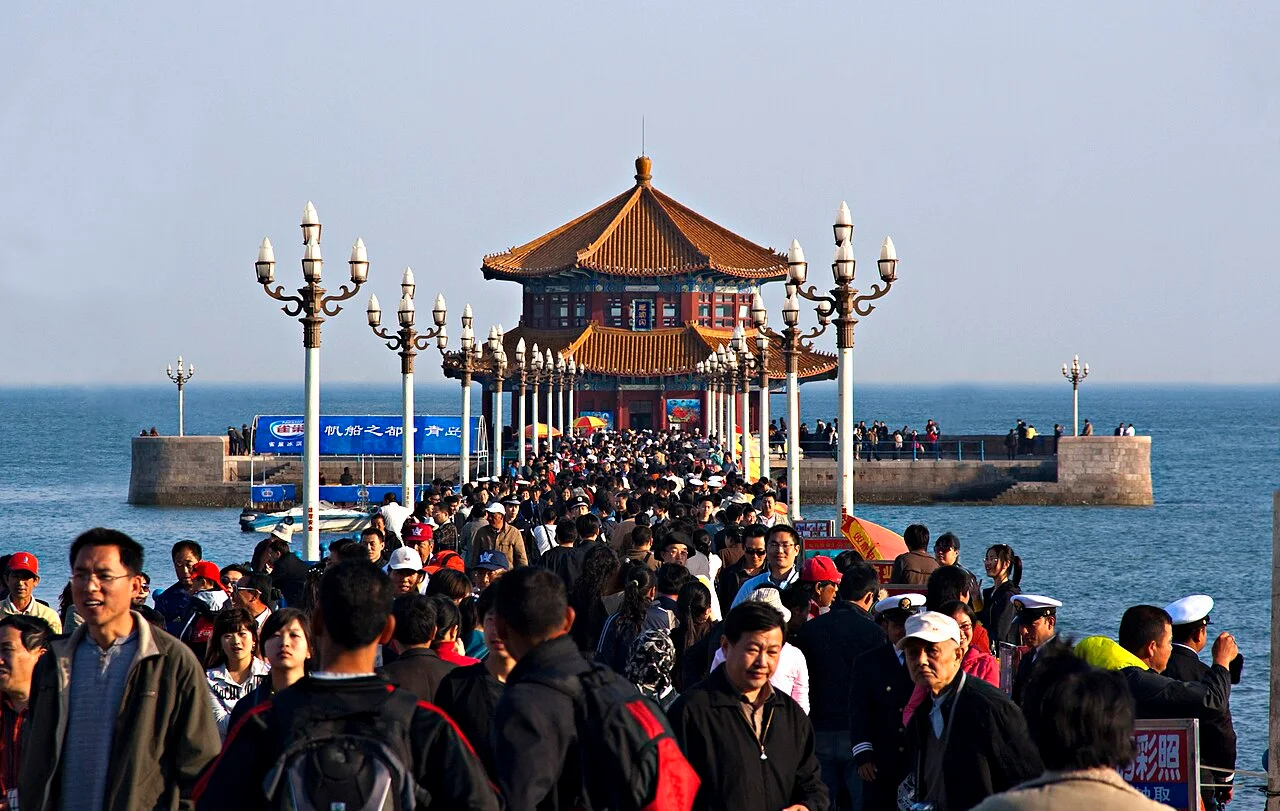
The deck is only 8–11.5 meters wide, and the entrance and the area in front of Huilan Pavilion are where people most often stop. In peak season, on holidays, and toward evening, tour groups, couples taking wedding photos, and families with strollers all crowd these two points, while the middle of the pier can actually be quicker to walk. The bridgehead is the junction of Taiping Road and Zhongshan Road, with constant traffic; check the signal before crossing. Once on the pier there is no shelter: summer midday sun is direct, and in winter the sea wind blows straight across. A round trip is about 800–900 meters; at a slow pace with photo stops, 40–60 minutes is enough.
There is no ticket for the pier deck and no reservation is required. Since 13 October 2026, Huilan Pavilion and the surrounding area have been closed for conservation work, scheduled for completion in mid-December; during construction the pavilion cannot be entered (checked on 11 November 2026). The closure centers on Huilan Pavilion and its surroundings, and how far you can walk on the pier depends on the barriers on site. If you only want the full view, there is no need to squeeze to the end: the Taiping Road waterfront, the Lu Xun Park side, and the direction of Little Qingdao all bring the pier, pavilion, and lighthouse into a single frame.
Useful official references
Check the relevant official service before making arrangements. These links are references, not a guarantee of current services.
- Qingdao Government Portal: Huilan Pavilion on Zhanqiao Pier to undergo conservation work (checked on 11 November 2026) ↗
- Qingdao Government Portal: Zhanqiao Pier (checked on 11 November 2026) ↗
- Qingdao Morning Post: Exploring the past and present of Qingdao's Zhanqiao Pier (checked on 11 November 2026) ↗